Sealants are never the star of the show, but without them, glass loosens, curtain walls leak, and RV roofs rattle. Different situations – different loads, materials, climates – require completely different sealing and bonding products.
Homey offers a full range of products from polyurethane foam to modified silane. Below are six realworld scenarios where our solutions are most often used. For each, we explain the product and why it works.
Scenario 1: Thermally Broken Aluminum Windows – PU Foam as a base, Silicone as finish
The problem: There is always a gap of several centimetres between the aluminum window frame and the wall. If you fill it only with cement, it cracks when dry; if you only use sealant, the thick sections will slump. Moreover, aluminum conducts heat easily, causing condensation around the window in winter.
Homey‘s approach:
First, use PU Foam (polyurethane foam) to fill the cavity between frame and wall. The foam expands, penetrates every small gap, and after curing forms a closedcell structure that insulates, reduces noise and stops air convection. The PU foam also has some adhesion, bonding the frame to the wall.
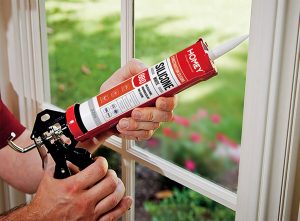
After the foam has fully cured, trim off the excess, then apply a bead of Silicone Sealant on the outside of the frame (at the joint between the glass or exterior finish and the frame). Silicone is the king of weather resistance – it withstands UV, acid rain, and temperatures from -50°C to +150°C. Its excellent elasticity follows the building‘s daily micromovements (wind pressure, thermal expansion) without cracking.
Result: Windows that don‘t leak air, don‘t form condensation, and keep out rain. The foam and sealant complement each other – foam fills large voids, silicone seals the surface.

Scenario 2: Metal Curtain Walls – Silicone for weathering, PU for shear strength
The problem: Metal curtain walls (aluminium or steel panels) have many large joints. During the day, the metal expands under the sun; at night it contracts. The joint movement can reach ±5 mm or more. Highrise wind pressure also makes panels vibrate repeatedly. Ordinary sealants fatigue and crack within months.
Homey‘s approach:
Exposed joints between metal panels must use Silicone Sealant. Why? Silicone offers the highest movement capability (up to ±50%) and its molecular structure hardly absorbs UV – it won‘t powder after 20 years of sunlight. Homey‘s buildinggrade silicone sealant is specifically designed for curtain wall joints, with a weather resistance guarantee of over 20 years.
Sometimes structural bonding is needed between the metal framework (behind the curtain wall) and the panels. Here silicone is not enough (its strength is relatively low). Instead, use PU Sealant (polyurethane). PU sealant has high shear strength, impact and vibration resistance. It can withstand repeated wind loads and adheres well to metal and coated surfaces, usually without primer.
Result: Panels stay stable, joints don‘t crack, and the curtain wall remains watertight, windproof and durable.

Scenario 3: Bus Roofs – MS Sealant, paintable and ecofriendly
The problem: A bus roof is a large FRP or aluminium panel that must be bonded to the metal side frame. When the bus moves, the body twists (torsional deformation); the roof joint must both bond firmly and move with the body. Also, the roof surface is finally painted in the body colour, so the sealant must accept paint. Many traditional PU sealants are not recommended for painting and may release isocyanates during curing – an unpleasant odour for workers.
Homey‘s approach:
Use MS Sealant (modified silane). MS sealant is onecomponent, roomtemperature moisture curing. It combines the weather resistance and elasticity of silicone with the strength of polyurethane. Most importantly, it is isocyanatefree and solventfree – safe and environmentally friendly. It can be overpainted after skinning without wrinkling or delamination.
MS sealant adheres well to FRP, aluminium, galvanised steel, etc., usually without primer. Its cure speed (approx. 3 mm/24h) allows enough working time without long waits.
Service temperature range: -40°C to +90°C, suitable for buses running anywhere.
Result: The roof is secure, no rattling during travel, the paint hides the adhesive line, and workers appreciate the low odour.

Scenario 4: RV Aluminium & Polyester (FRP) Bonding – PU for structure, MS for movement
The problem: An RV body is often a composite structure: outer skin (aluminium or FRP), insulation layer, inner decorative panel. Driving on rough roads twists the whole body continuously. Aluminium and FRP have different coefficients of thermal expansion. The bond line is severely tested. A very stiff adhesive may crack the skin; a very soft one may allow the skin to shift.
Homey‘s approach:
For highstrength structural bonding (e.g., between skin and framework), use PU Sealant. Cured PU has a higher modulus, effectively transferring forces and preventing the skin from bulging or detaching. Its initial strength builds quickly, so long clamping is not needed.
For elastic sealing (e.g., butt joints between aluminium and FRP, or between storage compartment doors and frames), use MS Sealant. MS sealant offers better elasticity to accommodate differential expansion. Inside the RV, its low odour and low VOC are a plus for living comfort.
Moreover, RVs often face rain, dirt and vibration; both MS and PU sealants have excellent water and aging resistance.
Result: Years later, the RV skin stays flat, joints remain dry, and there is no strange smell inside the cabin.

Scenario 5: Flooring Systems – Waterbased adhesive for coverings, PU sealant for joints
The problem: Indoor floors are not one solid block. They consist of coverings (carpet, PVC sheet, wood) on a concrete or selflevelling screed. The covering must be glued down to avoid bulging or shifting. Also, concrete floors have expansion joints that need filling – otherwise dust and moisture penetrate.
Homey‘s approach:
For bonding carpet or PVC flooring, use Waterbased Adhesive. Why waterbased? It uses water as the dispersion medium, almost no organic solvents, extremely low VOC. No irritating odour during application, safe for indoor air. Initial tack is moderate, allowing repositioning of the flooring. Strength builds as water evaporates. Homey‘s waterbased adhesive bonds well to carpet backing and PVC foam back.
For concrete expansion joints, fill with PU Sealant. These joints open and close repeatedly with temperature and humidity changes. PU sealant is elastic (elongation typically >400%) and follows the movement, yet is firm enough not to be indented by high heels. After curing, the surface is smooth and does not trap dust.
Result: Flooring stays flat without bubbles; expansion joints don’t leak or collect dirt; indoor air quality is good.

Scenario 6: NailFree Household Installation – Zero Nail Adhesive, hang heavy objects without drilling
The problem: At home, you want to hang a picture, a towel bar, or install skirting boards on tiled walls. Drilling may crack the tiles and leaves holes that are hard to repair. Ordinary glass glue doesn‘t hold – objects slowly slide down.
Homey‘s approach:
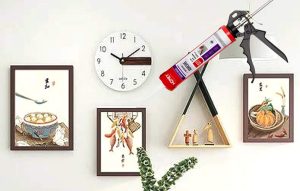
Use Zero Nail Construction Adhesive (Homey L322). This is not ordinary glue. It is a synthetic rubberbased, solventbased construction adhesive designed to replace nails. Two key features: fast grab – press the object against the wall for a few seconds, let go, and it stays; no need for tape for hours. High final strength – one thumbsized dot (approx. 5g), after full cure, typically holds a static load of 2030 kg. More than enough for a mirror or a shelf.
L322 works on most common home materials: tile, glass, metal, wood, MDF, PVC, stone, even many plastics. Service temperature -10°C to +90°C, suitable for bathrooms, balconies, kitchens. It is noncorrosive to mirror backing or tile glaze.
When you want to remove it later, soften the adhesive with alcohol or a dedicated remover, then scrape off with a plastic scraper. The wall remains intact.
Result: No hammer drill, no damaged walls, install a shelf in minutes – and it stays solid for months.

Choosing the right product is about matching the scenario
Many customers ask: “Which of your adhesives is the best?” The honest answer: there is no single “best” – only the best for your specific situation. For outdoor, sunexposed joints → silicone. For highstrength metal bonding → PU. For odoursensitive areas like vehicles or rooms → MS or waterbased. For avoiding drills at home → zero nail adhesive.
Homey‘s technical team can help you match the right product. If you are working on a project and are not sure which sealant or adhesive to use, contact us. We provide samples, application advice, and even onsite technical support.
Need more product information?
Please contact the Homey technical department or your local authorised distributor. We don‘t hardsell; we help you find the product that truly fits.
Quick FAQ
Q: Are PU foam and PU sealant the same thing?
A: No. PU foam is an expanding foam used for filling large gaps, insulation and soundproofing. PU sealant is a paste used for bonding and sealing with high strength.
Q: Can MS sealant replace silicone on curtain walls?
A: Partially, but MS generally has lower UV resistance than pure silicone. For exposed curtain wall joints, silicone remains the preferred choice. MS can be used indoors or in shaded areas.
Q: Can zero nail adhesive be used outdoors?
A: Yes, but avoid longterm water immersion. The working temperature range is -10°C to +90°C, so normal outdoor weather is fine.
Q: Is waterbased adhesive suitable for PVC flooring?
A: Yes. Homey‘s waterbased adhesive provides good adhesion to PVC backing and foam backing, and meets indoor environmental standards.
Q: What is the shelf life of these products?
A: Store below 25°C in a cool, dry place. Most products have a shelf life of 12 months.